Signed in as:
filler@godaddy.com
Signed in as:
filler@godaddy.com
The ISSB's global standards are now reshaping law in Australia and Singapore. Auverde helps you turn a compliance deadline into a credible, board-ready climate disclosure — guided by specialists who work inside this framework every day.
The International Sustainability Standards Board (ISSB) is a global standard-setter established under the IFRS Foundation. In 2023 it released IFRS S1 and IFRS S2 — the first globally consistent baseline standards for sustainability- and climate-related financial disclosure.
Since then, jurisdictions across Asia-Pacific — including Australia and Singapore — have moved to adopt or closely align local reporting law with these standards. That's what makes ISSB-aligned disclosure different from earlier voluntary ESG frameworks: it's built to sit inside financial reporting, subject to the same rigour, timelines, and increasingly, assurance expectations as your annual report.
For most businesses, this isn't a marketing exercise. It's a new line item in statutory reporting obligations — and one that touches finance, risk, legal, operations, and the board all at once.
ISSB reporting is disclosure prepared under IFRS S1 and IFRS S2, requiring organisations to explain their climate-related governance, strategy, risk management, and performance metrics — built on, and extending, the earlier TCFD framework.
Australia and Singapore are taking different regulatory routes to the same destination — mandatory, ISSB-aligned climate disclosure. Here's where each currently stands.
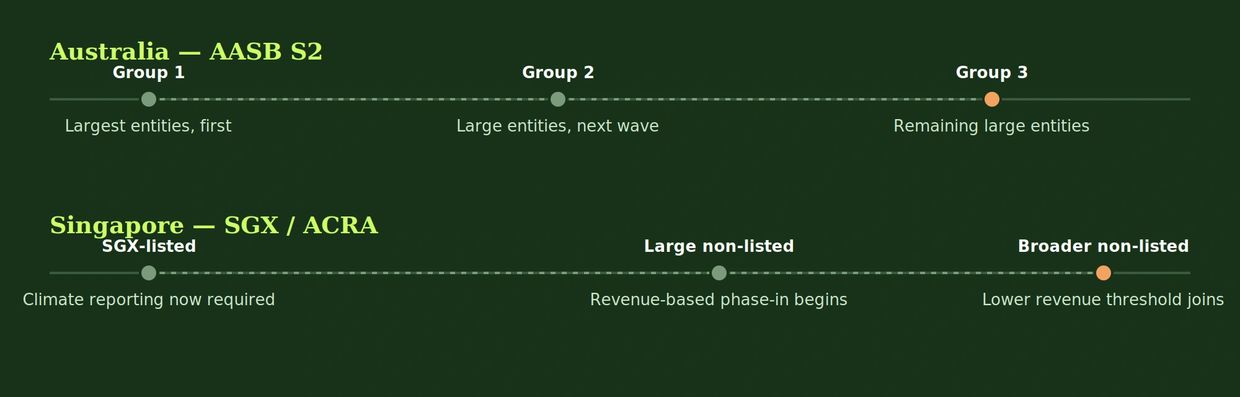
Exact thresholds and start dates move as regulators finalise guidance — AASB S2 phase-in is set by consolidated revenue, assets and employee thresholds under the Corporations Act; Singapore's timeline follows recommendations from the Sustainability Reporting Advisory Committee, jointly convened by ACRA and SGX RegCo. We track both regimes and will confirm exactly where your entity sits.
IFRS S2 inherited its structure from TCFD. Whether you're reporting under AASB S2 or SGX's requirements, your disclosure needs to answer all four — not just publish an emissions number.
How the board and management oversee, and are accountable for, climate-related risks and opportunities.
Board oversight · management role · reporting lines
The actual and potential impacts of climate risks and opportunities on the business, strategy and financial planning — including scenario analysis.
Resilience testing · transition plans · financial impact
How climate risks are identified, assessed, prioritised and integrated into the organisation's overall risk management process.
Identification · assessment · integration
The metrics and targets used to manage climate risks and opportunities, including Scope 1, 2 and, where material, Scope 3 emissions.
GHG inventory · targets · progress tracking
Our approach moves through the same order most reporting teams need to follow — because getting the sequence right the first time is what keeps a mandatory deadline from becoming a fire drill.
Gap analysis against IFRS S2, AASB S2 or SGX requirements, plus a materiality assessment to focus effort where it counts.
Target governance structure, reporting lines and the data architecture needed to capture climate metrics reliably, year on year.
Scenario analysis, Scope 1–3 emissions inventory, risk quantification, and drafting of the narrative disclosure itself.
Board-ready disclosure, assurance-readiness support, and a monitoring cadence so next year starts from data, not from scratch.
ISSB reporting refers to disclosure prepared under IFRS S1 and IFRS S2, the global sustainability and climate disclosure standards issued by the International Sustainability Standards Board, part of the IFRS Foundation. IFRS S1 sets general requirements for disclosing sustainability-related risks and opportunities; IFRS S2 sets climate-specific requirements covering governance, strategy, risk management, and metrics and targets.
Yes. Australia has adopted ISSB-aligned climate disclosure through AASB S2 Climate-related Financial Disclosures, made mandatory under amendments to the Corporations Act. It is being phased in by entity size across three groups, with the largest entities reporting first and smaller entities following in later financial years.
Singapore is phasing in ISSB-aligned climate reporting. SGX-listed issuers are required to report climate-related disclosures aligned with ISSB standards, and large non-listed companies are being brought into scope on a phased timeline following recommendations from the Sustainability Reporting Advisory Committee, jointly convened by ACRA and SGX RegCo.
IFRS S2 was built directly on the TCFD framework and uses the same four pillars — governance, strategy, risk management, and metrics and targets. In effect, ISSB is TCFD's successor as a mandatory, globally consistent disclosure baseline, with more prescriptive metrics, scenario analysis, and Scope 1, 2 and 3 emissions requirements than TCFD's original recommendations.
Most organisations need six to twelve months to move from an initial gap assessment to a board-ready first disclosure, depending on the maturity of existing data systems, governance structures, and whether a full Scope 1-3 emissions inventory and climate scenario analysis already exist.
No. Emissions data sits within the metrics and targets pillar, but ISSB/IFRS S2 also requires disclosure of climate governance arrangements, strategic resilience under different climate scenarios, and how climate risks and opportunities are identified and managed — a broader disclosure than emissions accounting alone. If you're starting from an emissions inventory, our emissions reporting service plugs directly into the metrics pillar of this work.
Email us directly via info@auverde.com, or


In the spirit of reconciliation, auverde acknowledges the Traditional Custodians of the land on which we operate, the Bunurong people of the Kulin Nation. We recognise their enduring connection to the land, waters, and culture, and we pay our respects to their Elders, past and present.
We extend that respect to all Aboriginal and Torres Strait Islander peoples.
Copyright © 2026 auverde - All Rights Reserved.
We use cookies to analyse website traffic and optimise your website experience. By accepting our use of cookies, your data will be aggregated with all other user data.