auverde
auverde
  • Home
  • Services
    • AASB S2 Reporting
    • ISSB Reporting
    • Emissions reporting
    • Net Zero Roadmap
    • Climate Risk Assessment
    • Fractional CSO
    • Sustainability Strategy
    • ESG reporting
    • Life Cycle Assessments
    • SBTi
    • Certification support
  • Blog
  • About us
  • Career
  • Contact us
  • More
    • Home
    • Services
      • AASB S2 Reporting
      • ISSB Reporting
      • Emissions reporting
      • Net Zero Roadmap
      • Climate Risk Assessment
      • Fractional CSO
      • Sustainability Strategy
      • ESG reporting
      • Life Cycle Assessments
      • SBTi
      • Certification support
    • Blog
    • About us
    • Career
    • Contact us
  • Sign In

  • My Account
  • Signed in as:

  • filler@godaddy.com


  • My Account
  • Sign out

Signed in as:

filler@godaddy.com
  • Home
  • Services
    • AASB S2 Reporting
    • ISSB Reporting
    • Emissions reporting
    • Net Zero Roadmap
    • Climate Risk Assessment
    • Fractional CSO
    • Sustainability Strategy
    • ESG reporting
    • Life Cycle Assessments
    • SBTi
    • Certification support
  • Blog
  • About us
  • Career
  • Contact us

Account

  • My Account
  • Sign out

  • Sign In
  • My Account

Life cycle assessment, led by the person who helped define how it's done.

 Dr. Ina Peukes has worked in life cycle assessment since 2016 — from early research on wall insulation to a PhD applying primary-data LCA to HVAC systems, with a contribution to CIBSE TM65 along the way. 


auverde applies that same rigour across the built environment and beyond: mapping your product and service supply chains, aligned with ISO 14040/44 and the GHG Protocol, all the way through to a finished EPD. 

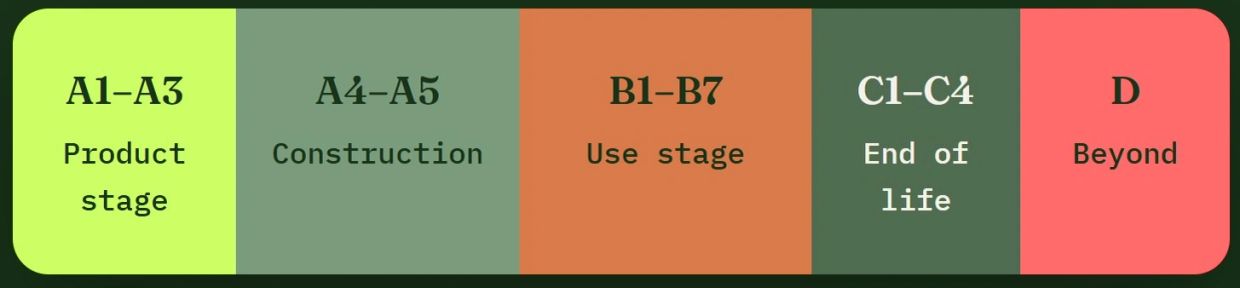
 The EN 15804 life cycle stages — the map every auverde assessment is built around. 

About Dr Ina Peukes

  • PhD in Life Cycle Assessment
  • Contributor to CIBSE TM65 — Embodied Carbon in Building Services: A Calculation Methodology
  • One of the first to run a life cycle assessment on an HVAC system using primary data


In 2016, Ina's master's thesis was about applied life cycle assessment to four types of wall insulation — already an established methodology, but one the built environment wasn't yet using in everyday practice. In 2018, Ina began a PhD applying that same rigour to HVAC systems, this time building primary data into the assessment rather than relying on database averages.


Partway through that PhD, Ina was invited to contribute to CIBSE TM65 — Embodied Carbon in Building Services: A Calculation Methodology — published in 2021. Ina helped shape the industry's methodology before she'd published her own PhD research, which came out in 2023.


Since then, the same approach has taken me across the wider built environment: products, materials, and services, wherever a business needs a life cycle assessment rigorous enough to publish, defend, and act on.


Ina started auverde because that rigour shouldn't be reserved for landmark research projects. Every business making, installing, or specifying a product or service deserves an assessment built on the best available data, aligned with the standards that matter, and clear enough to act on. That's what we do, every time — and we do it with you, not just for you.

A life cycle assessment measures impact across the whole story of a product or service.

A life cycle assessment (LCA) quantifies the environmental impact of a product or service across its entire life — from raw material extraction, through manufacturing and distribution, to use and end of life. Done properly, in line with ISO 14040 and ISO 14044, an LCA is what sits underneath a credible carbon footprint, an Environmental Product Declaration (EPD), or a GHG Protocol Scope 3 disclosure. The international standard EN 15804 breaks that life cycle into modules — and mapping your supply chain against them is where every auverde assessment starts. 

A1–A3 Product stage

A1–A3 Product stage

A1–A3 Product stage

Raw material supply, transport to manufacturer, and manufacturing itself. 

A4–A5 Construction

A1–A3 Product stage

A1–A3 Product stage

Transport to site and installation or construction processes. 

B1–B7 Use stage

A1–A3 Product stage

C1–C4 End of life

Use, maintenance, repair, replacement, refurbishment, and operational energy/water. 

C1–C4 End of life

D Beyond the boundary

C1–C4 End of life

Deconstruction, transport, waste processing, and disposal. 

D Beyond the boundary

D Beyond the boundary

D Beyond the boundary

Benefits and loads from reuse, recovery, and recycling potential. 

From your supply chain to a finished, decision-ready assessment.

Six steps, grounded in the same standards used to write CIBSE TM65 — applied to your product, your service, and your supply chain. 

01 Map your product & service supply chain

We map your product supply chain — every supplier, material, process, and mile it takes to bring what you make or deliver into being. This sets the goal and scope of the assessment and tells us exactly which EN 15804 modules and GHG Protocol scopes apply. 

02 Support your data collection

Good LCA lives or dies on data quality. We work directly with your suppliers, operations, and finance teams to gather primary data wherever it exists, and apply verified secondary data transparently everywhere it doesn't. No black boxes, no generic assumptions dressed up as precision. 

03 Model the full life cycle

Using ISO 14040/44-compliant modelling, we calculate impacts across global warming potential and other environmental indicators for every relevant life cycle stage — cradle to grave, or cradle to gate, whichever answers the question you're actually asking. 

04 Report with clarity

You get a report built for two audiences at once: reviewers who need it to survive scrutiny, and decision-makers who need to act on it in five minutes. Every claim is traceable and aligned with the GHG Protocol Product and Corporate Standards. 

05 Turn it into an EPD

If you need an Environmental Product Declaration, your LCA is already most of the way there. We prepare EPDs to ISO 14025 and EN 15804, mapped to the relevant Product Category Rules, and support you through independent third-party verification. 

06 Find where to improve

A number without a next step isn't useful. We identify your carbon hotspots and hand you a prioritised, practical set of reduction options — the ones that actually move your number, not the ones that just look good in a slide. 

From LCA to EPD — Your life cycle assessment is the hard part. The EPD comes next.

An Environmental Product Declaration (EPD) is a standardised, independently verified document that communicates the results of a life cycle assessment to customers, specifiers, and green building rating tools. It's built to ISO 14025 and, for construction products, EN 15804, following the relevant Product Category Rules (PCR).


Because we build every LCA to the same standards an EPD requires, there's no rework and no second consultant needed to translate your data. We take you from raw supply-chain data through to a verifier-ready EPD, using the same primary-data rigour that underpins CIBSE TM65.

Where EPDs get published

Once your EPD is verified, it's typically registered with a recognised programme operator. We can guide you to the right one for your market: 

International EPD System (EPD International)
EPD Australasia
ECO Platform (European EPD programmes)

Where we specialise

Products and building services — one team, both supply chains.

Construction products & materials

Scope 3 & product carbon footprints

Construction products & materials

 EN 15804-aligned assessments for manufacturers who need to publish EPDs their specifiers and rating tools will actually accept. 

Manufactured products & equipment

Scope 3 & product carbon footprints

Construction products & materials

 Cradle-to-grave or cradle-to-gate LCA for physical products, wherever they sit in your catalogue. 

Scope 3 & product carbon footprints

Scope 3 & product carbon footprints

Scope 3 & product carbon footprints

 GHG Protocol-aligned product-level data that feeds directly into your corporate Scope 3 disclosure. 

Why auverde

 What you get that a generic sustainability consultancy can't offer.

Led by a PhD, not handed to a junior analyst

Dr. Ina Peukes is directly involved in scoping and reviewing your assessment — not a name on a website who delegates the work. 

We push for primary data, not database defaults

Wherever your suppliers are willing and able to share real figures, we use them. Secondary data fills the gaps — always documented, so you know exactly what's measured and what's modelled. 

Dual expertise: product and service supply chains

 Most consultancies map one or the other. We map both, because most real-world footprints span them. 

A direct line from LCA to EPD

 One team, one dataset, one standard — from first supply-chain interview to a verifier-ready Environmental Product Declaration. 

Frequently Asked Questions

A life cycle assessment (LCA) consultant maps a product or service's environmental footprint across its full life cycle — raw materials, manufacturing, use, and end of life — following ISO 14040 and ISO 14044. auverde also supports data collection, GHG Protocol-aligned reporting, EPD development, and practical carbon reduction recommendations.


 An LCA is the underlying study that calculates environmental impacts across a product's life cycle. An Environmental Product Declaration (EPD) is a standardised, independently verified document, built to ISO 14025 and EN 15804, that communicates those LCA results publicly. A compliant LCA is required before an EPD can be produced. 


The GHG Protocol Corporate Accounting and Reporting Standard is the most widely used international framework for measuring and reporting greenhouse gas emissions. It defines the three scopes of emissions, sets out methodological requirements, and provides the basis for most national and international disclosure standards. 


Yes. Every auverde life cycle assessment is aligned with the GHG Protocol Product Life Cycle Accounting and Reporting Standard and, where relevant, the Corporate Standard for Scope 3 reporting, alongside ISO 14040 and ISO 14044. 


Both — but we start with primary data wherever it's available, because it produces results you can defend and act on. Secondary data is used transparently, and only where primary data genuinely isn't accessible. 


Timelines depend on scope and data availability, but most single-product or single-service assessments run 6–10 weeks from kick-off to final report once data collection is underway. 


Cost depends on the complexity of your supply chain, the number of products or services in scope, and how much primary data is already available. Book a scoping call and we'll give you a clear, fixed-scope quote — no vague ranges. 


Ready to see your supply chain clearly?

Tell us about your product, your service, or the EPD you need — we'll come back with a clear, fixed-

Email us directly via info@auverde.com, or

Contact us here

This site is protected by reCAPTCHA and the Google Privacy Policy and Terms of Service apply.

Cancel

Our Memberships

We are a part of 1% for the Planet
This means we donate one percent of our revenue for the good of o
  • Home
  • Services
  • About us
  • Career
  • Contact us

In the spirit of reconciliation, auverde acknowledges the Traditional Custodians of the land on which we operate, the Bunurong people of the Kulin Nation. We recognise their enduring connection to the land, waters, and culture, and we pay our respects to their Elders, past and present.


We extend that respect to all Aboriginal and Torres Strait Islander peoples.

Copyright © 2026 auverde - All Rights Reserved.

This website uses cookies.

We use cookies to analyse website traffic and optimise your website experience. By accepting our use of cookies, your data will be aggregated with all other user data.

Accept